About RECOM
The RElocatable COastal Model (RECOM) is an interactive web based modelling tool developed by CSIRO. It allows users to define a fine-scale resolution grid in a local area of interest and is driven by the larger scale GBR4 and GBR1 models. It is full featured in terms of running the hydrodynamics, sediment transport and BGC models. Custom data, such as bathymetry, coastlines and flow data may be supplied by the user. The higher resolution (~100’s of m) of the grids enables the model to capture more of the local dynamics that may be missing from the broader regional models.
The current phase of eReefs aims to extend RECOM to nearshore coastal and estuarine applications, with the ability to define the riverine features more accurately.
The RECOM web application is used to generate model grids and RECOM EMS Model Workspaces that use those grids:
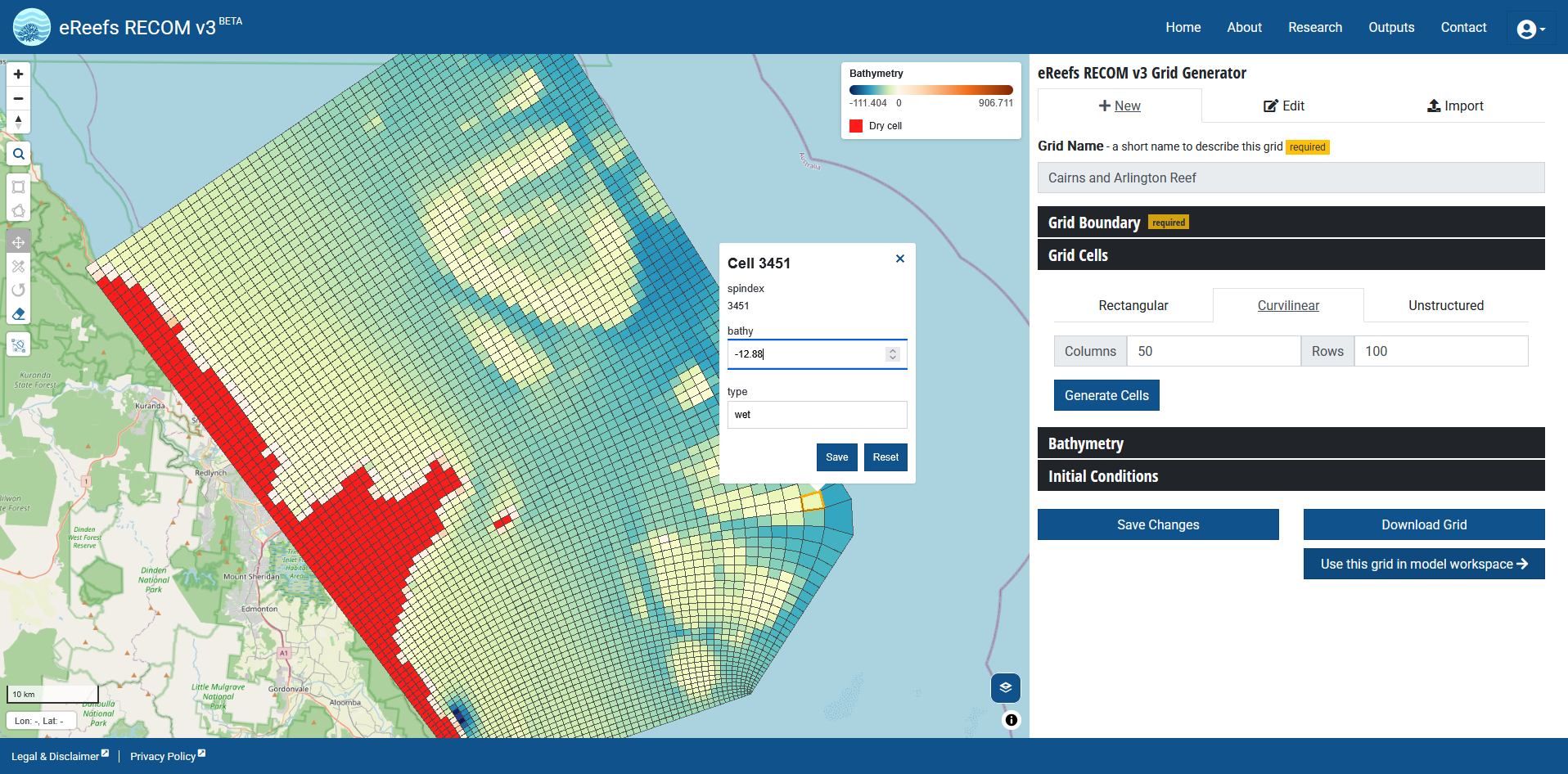
The RECOM workspaces must then be downloaded to a high-performance compute environment which is co-located with the RECOM forcing datasets to run the model.
Earlier versions of RECOM were able to run small RECOM instances directly from the RECOM web application, but we are no longer able to provide compute resources for that purpose.
Who can use eReefs RECOM?
Access to eReefs RECOM is restricted to authorised users who already have access to a supported compute environment. At present, the only supported environment is NCI Gadi, so all RECOM users must qualify for an NCI Access Scheme.
- If you are an existing RECOM user then you can access the RECOM Grid Generation and Workspace Generation tools here.
- If you would like to become a RECOM user and you already have NCI Gadi access, please contact the eReefs team here to apply for eReefs RECOM access and advice.
eReefs RECOM Case Studies
RECOM has historically been used mostly as an offshore downscaling tool. The case studies listed below demonstrate some of those applications:
Down-scaled Hydrodynamics
Down-scaled Biogeochemistry
RRAP Cooling and Shading Sites
RECOM was used extensively to model significant locations associated with research for the Reef Restoration and Adaptation Program (RRAP).
Peer-reviewed Papers using RECOM
Baird, M.E., M. Mongin, F. Rizwi, L. Bay, N. Cantin, L. Morris (2021) The effect of natural and anthropogenic nutrient and sediment loads on coral oxidative stress on runoff-exposed reefs. Mar. Poll. Bull. 168, 112409
Baird ME, Green R, Lowe R, Mongin M, Bougeot E (2020) Optimising cool-water injections to reduce thermal stress on coral reefs of the Great Barrier Reef. PLoS ONE 15(10): e0239978. https://doi.org/10.1371/journal.pone.0239978.
Baird, M. E., K. Wild-Allen, J. Parslow, M. Mongin, B. Robson, J. Skerratt, F. Rizwi, M. Soja-Woźniak, E. Jones, M. Herzfeld, N. Margvelashvili, J. Andrewartha, C. Langlais, M. Adams, N. Cherukuru, S. Hadley, P. Ralph, T. Schroeder, A. Steven, U. Rosebrock, L. Laiolo, M. Gustafsson, and D. Harrison (2020). CSIRO Environmental Modelling Suite (EMS): Scientific description of the optical and biogeochemical models (vB3p0). Geoscientific Model Development.13:4503-4553.
Baird, M. E., M. Mongin, F. Rizwi, L. K. Bay, N. E. Cantin, M. Soja-Wozniak and J. Skerratt (2018) A mechanistic model of coral bleaching due to temperature-mediated light-driven reactive oxygen build-up in zooxanthellae. Ecol. Model 386: 20-37.