• Skip to primary navigation
  • Skip to content
  • Skip to footer
eReefs eReefs
  • Home
  • About
  • Research
  • Outputs
  • Contact

    eReefs Data Access Notebooks

    Photography by Gary Cranitch, Queensland Museum
    • About eReefs
      • Collaborators
      • Funding
      • Acknowledgements
    • eReefs Research
      • Remote Sensing
      • In-Situ Observations
      • Modelling System and Framework
      • Water Quality Scenarios
      • Pesticide Modelling and Management
      • Relocatable Coastal Modelling (RECOM)
      • Oil Spill Detection
      • References
    • eReefs Outputs
      • Web Applications
      • Open Access Datasets
      • Data Access Tools and Tutorials
      • Open Source Software
      • Scientific Publications
      • Impact Evaluations
      • Media Mentions
    • Reef 2050 Plan
      • Reef Water Quality Report Cards
    • eReefs in Action
      • Reef Snapshot Reports
      • Reef Restoration and Adaptation Program
      • COTS Control and Innovation Program
      • Biodiversity and Threatened Species
    • Contact Us

    On this page

    • eReefs Data Access Notebooks
      • Code Repository Location
      • Usage Instructions
      • Featured Examples
    1. Home
    2. /
    3. Outputs
    4. /
    5. Open source software
    6. /
    7. eReefs Data Access Notebooks

    eReefs Data Access Notebooks

    Jupyter Notebooks for Python + emsarray + eReefs data access

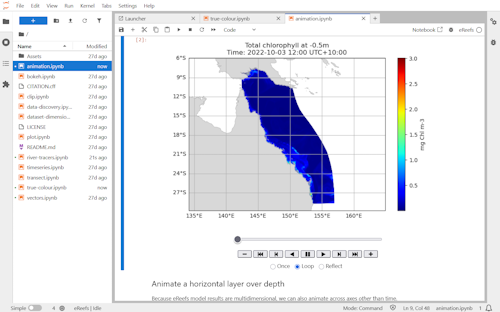
    Preview of eReefs Data Access Notebooks

    The CSIRO team behind the eReefs Data Explorer and emsarray have joined forces to create a suite of Jupyter notebooks with working examples of how to use emsarray to access, manipulate and visualise eReefs model results datasets in Python.

    Code Repository Location

    You can find the notebooks at https://github.com/eReefs/ereefs-data-access-notebooks

    Usage Instructions

    For instructions about how to launch and run these notebooks, please refer to the README.md file in the code repository

    Featured Examples

    • Discovering eReefs dataset dimensions in real-world coordinates (rather than grid-indices)
    • Extracting a timeseries at a point from eReefs model results
    • Plotting data variables from eReefs model results on a map with bokeh
    • Plotting data variables from eReefs model results on a map with matplotlib
    • Plotting vector field variables from eReefs model results on a map with matplotlib
    • Clipping (subsetting) eReefs data to a region of your choice
    • Extracting eReefs transect data, as either a line or as a vertical cross-section
    • Animating eReefs model results
    • Generating a simulated true colour plot from eReefs BGC reflectance variables

    Updated: March 20, 2026

    Previous Next

    eReefs is a collaboration between:

    Logo for AIMS Logo for Bureau of Meteorology Logo for CSIRO Logo for Queensland Government

    Currently supported by:

    Logo for Australian Government Reef Trust

    Previously Supported by:

    Logo for The Great Barrier Reef Foundation Logo for Queensland Government Logo for Science and Industry Endowment Fund Logo for BHP Billiton Mitsubishi Alliance
    Copyright and Licence Privacy
    © 2026 eReefs. Powered by Jekyll & Minimal Mistakes.